Various types of grinders are used for finishing the surface of parts.
Round part’s surfaces are finished using ID/OD grinders, which stand for outside diameter and inside diameter grinders.
Flat parts are finished using a surface grinder.
Grinders can be very dangerous pieces of equipment to use, due to the enormous amounts of centrifugal force that is caused by the high RPMs of the grinding disk, a disk with a crack in it has the potential for breaking up and spewing into many high speed projectiles!
The surface grinder
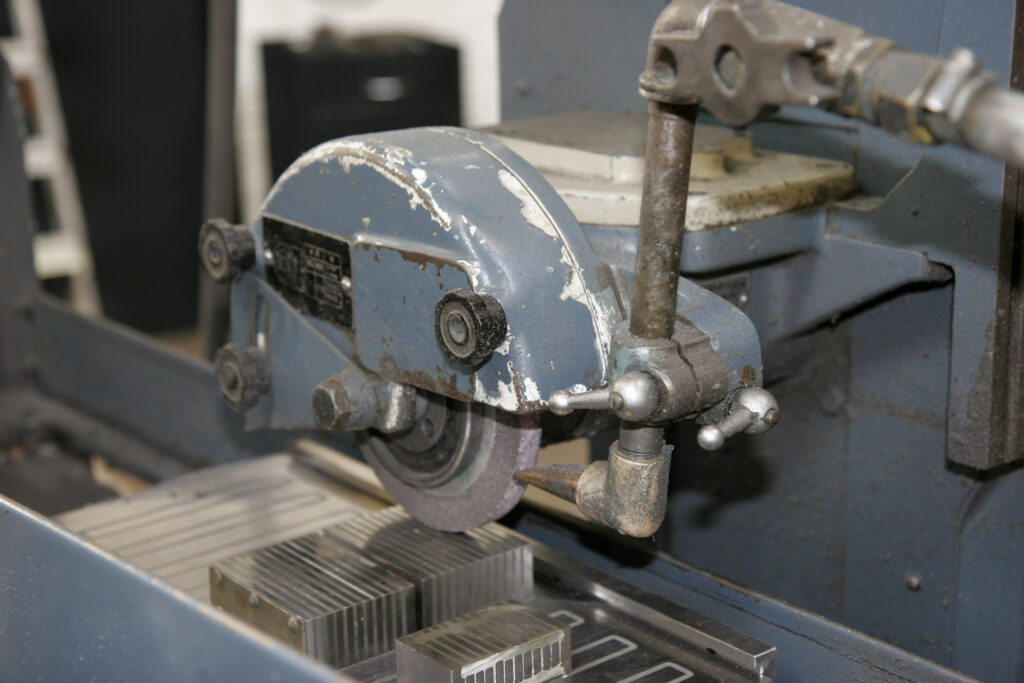
A surface grinder is used to finish the surface of a flat work piece. The workpiece is held in place by a magnetic base. It is important to use coolant when using a surface grinder.
Use of a Surface Grinder in Machining Parts
A surface grinder is a precision machine tool used to produce a flat, smooth, and accurately sized surface on a workpiece. It uses a rotating abrasive grinding wheel to remove a small amount of material from the surface.
How a surface grinder is used
• Workholding: The workpiece is commonly held on a magnetic chuck, but clamps or other fixtures may be used for non-magnetic materials.
• Grinding wheel: A rotating abrasive wheel is positioned above the workpiece and removes material as it passes across the surface.
• Material removal: The table moves the workpiece back and forth under the grinding wheel while the wheel is fed downward in small increments.
• Coolant: Grinding fluid may be used to control heat, prevent burning, and improve surface finish.
• Sizing: Multiple passes are made until the workpiece reaches the required thickness or dimension.
• Finishing: Fine grinding passes can produce a smooth surface with a high degree of flatness and accuracy.
Typical applications
• Surface grinders are commonly used for:
• Producing flat and parallel surfaces
• Finishing machine components
• Grinding hardened steel parts
• Precision plates and blocks
• Dies, molds, and tooling
• Removing small amounts of material after milling
The main advantage of a surface grinder is its ability to produce very flat, accurate surfaces with excellent surface finishes, especially when tight dimensional tolerances are required.
The OD grinder – outside diameter
An OD (Outside Diameter) grinder is a precision machining machine used to grind the external cylindrical surfaces of a workpiece. It removes a small amount of material with an abrasive grinding wheel to achieve very accurate dimensions, roundness, and surface finish.
How an OD grinder is used
• Workholding: The part is typically held between centers, in a chuck, or with another suitable fixture. Parts such as shafts, pins, bushings, and bearing components are common applications.
• Grinding wheel: An abrasive wheel rotates at high speed and contacts the outside diameter of the workpiece.
• Material removal: The wheel removes material through controlled grinding passes. The operator or CNC system controls the depth of cut and feed rate.
• Coolant: Grinding fluid is usually directed at the grinding zone to control heat, reduce thermal damage, and flush away grinding debris.
• Sizing: Successive passes bring the part to its specified diameter. Precision measurement equipment or in-process gauging may be used to verify the dimension.
• Finishing: A final light grinding pass can produce a very smooth surface and tight dimensional tolerances.
Typical applications
OD grinders are commonly used for:
• Precision shafts and axles
• Bearing races and components
• Hydraulic and pneumatic components
• Pins and bushings
• Tooling and machine components
• Parts requiring tight diameter and roundness tolerances
The main advantage of an OD grinder is that it can produce very precise external diameters and excellent surface finishes, often after turning or other rough-machining operations.
It is important to inspect the OD grinder wheel before use for cracks, to ensure that it does not explode.
The ID grinder – inside diameter
Use of an ID Grinder in Machining Parts
An ID (Inside Diameter) grinder is a precision grinding machine used to machine the internal surfaces of holes, bores, and cylindrical openings in a workpiece. It removes small amounts of material using a rotating abrasive wheel to achieve accurate dimensions, roundness, and surface finish.
How an ID grinder is used
• Workholding: The workpiece is securely held in a chuck, fixture, or other appropriate holding device.
• Grinding wheel: A small-diameter abrasive wheel mounted on a spindle enters the hole or bore and • rotates at high speed.
• Material removal: The grinding wheel makes controlled passes along the inside diameter, gradually removing material.
• Coolant: Grinding coolant is applied to control heat, prevent thermal damage, and remove grinding particles.
• Sizing and inspection: The bore is measured during or after grinding using tools such as bore gauges, plug gauges, or precision measuring equipment.
• Finishing: Light finishing passes are used to obtain the required diameter, roundness, and surface finish.
Typical applications
ID grinders are commonly used for:
• Bearing bores and races
• Bushings and sleeves
• Precision holes
• Hydraulic cylinder components
• Gears and transmission components
• Tool holders and machine-tool components
The main advantage of an ID grinder is its ability to produce highly accurate internal diameters with excellent roundness and surface finish, particularly when close tolerances are required.
Grinders used for sharpening.
Grinding wheels are used for sharpening many types of tools such as drill bits. Various types of cutting tools are also shaped using a grinder. Threading tools used with a lathe can be made with a grinder.
Caution should be taken when changing the grinding wheels on any type of grinder.
It is important to check the grinding wheel before use, the grinding wheel should always be checked for cracks. Checking for cracks can be done by lightly tapping the grinding wheel and ringing it and listening to the sound. The sound should sound ring and not have a dull sound.
The centrifugal force from the spinning grinding if cracked can cause it to explode.
The workpieces are held in place by a magnetic base.
The magnetic base is usually activated by a lever. It is important that the workpiece is held in place securely when grinding the workpiece. The magnetic base is used with surface grinders.